
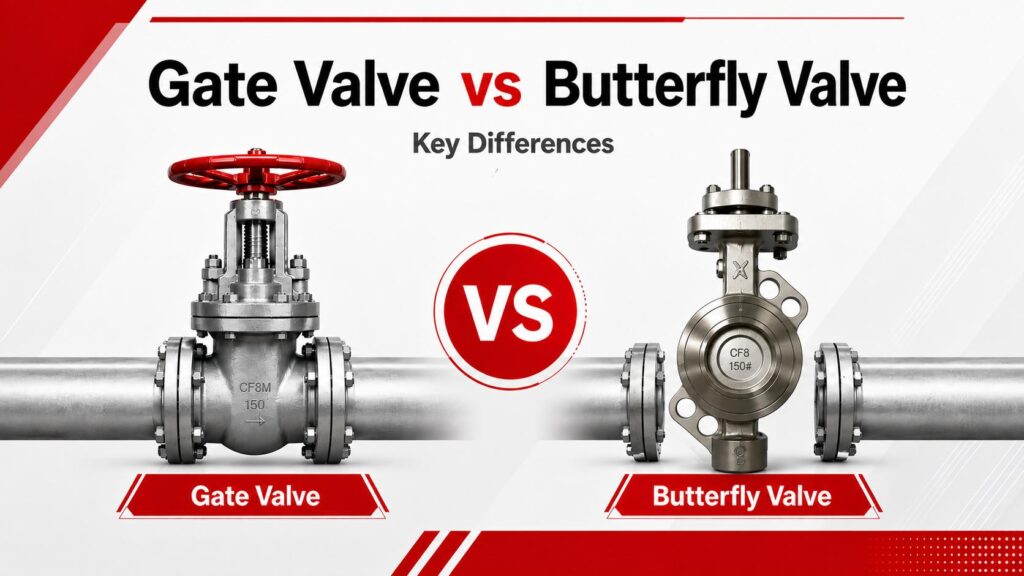
Choosing the right valve can affect flow performance, maintenance, installation space, and system reliability. Two common options are the butterfly valve and gate valve, but they are designed with different operating characteristics and applications in mind.
For example, Malaysia is currently investing heavily in water infrastructure renewal. In July 2026, the government approved RM1.7 billion to replace about 1,800 km of ageing water pipes between 2026 and 2030, highlighting the importance of reliable components in water distribution systems.
So, when should you choose a butterfly valve over a gate valve—and when is a gate valve the better option?
Where Are Butterfly Valves and Gate Valves Used?
Both valve types can be used to isolate sections of a piping system, but their designs make them better suited to different applications.
Gate Valve
A gate valve uses a gate or wedge that moves vertically to block or allow flow. When fully open, the gate retracts from the flow path, providing relatively low resistance. Gate valves are primarily intended for full open or full closed isolation, rather than continuous flow control.
Common applications include:
- Water pipelines
- Steam systems
- Oil and gas systems
- Industrial process lines
- Pumping systems
- Power generation
Butterfly Valve
A butterfly valve uses a disc that rotates around a shaft to open or close the flow path. Its compact design and relatively low weight make it suitable for larger pipelines and applications where installation space is limited.
Common applications include:
- Water supply and distribution
- Wastewater systems
- Cooling water
- HVAC systems
- Process industries
- Power generation
- Large-diameter pipelines
Butterfly valves can also be used for flow regulation when the valve design is suitable for throttling.
Gate Valve vs Butterfly Valve: Key Differences
| Factor | Gate Valve | Butterfly Valve |
|---|---|---|
| Main function | Primarily isolation | Isolation and, depending on design, flow regulation |
| Operating mechanism | Rising/falling gate | Rotating disc |
| Size and weight | Typically larger and heavier | Generally compact and lightweight |
| Installation space | Requires more space, particularly above the valve | Requires less space |
| Operation | Multiple turns | Quarter-turn |
| Large pipelines | Can also be used, but may require more space and material | Well suited to larger pipe sizes |
| Pressure drop | Relatively low when fully open | Some resistance from the disc |
| Throttling | Generally not recommended | Suitable for some designs/applications |
| Typical applications | Water, steam, oil and industrial isolation | Water, wastewater, cooling and process systems |
| Best suited for | Full isolation where low flow resistance is important | Compact installation and larger pipelines |
The actual performance depends on the specific valve design, size, pressure class, materials, and operating conditions. Valve selection should therefore be based on the complete system rather than valve type alone.
Butterfly Valve vs Gate Valve: Which Should You Choose?
Choose a Gate Valve When:
A gate valve may be more suitable when:
- Full open/full closed isolation is required
- Low pressure drop when fully open is important
- The system handles water, oil, steam, or other compatible fluids
- The installation can accommodate the valve’s larger space requirements
- Throttling is not required
For either option, consider the fluid type, pressure, temperature, pipe size, connection, materials, installation conditions, and operating frequency before making a final selection.
Choose a Butterfly Valve When:
A butterfly valve may be suitable when:
- Space is limited
- The pipeline is relatively large
- Quick quarter-turn operation is preferred
- Lower valve weight is beneficial
- The application involves water or other liquid systems
- Flow regulation is required and the valve is designed for it
Spirax Sarco notes that butterfly valves are commonly used in liquid systems where space is limited, and their compact construction makes them suitable for large pipelines.
Apex Uniparts Gate and Butterfly Valve Solutions
Apex Uniparts supplies a range of industrial valves in Malaysia for water, steam, oil, process, and other industrial applications.
Its industrial valve range includes solutions such as:
- Butterfly valves
- Gate valves
- Globe valves
- Ball valves
- Check valves
- Safety valves
- Other specialised valves
This allows customers to select different valve configurations according to their system requirements rather than relying on a one-size-fits-all solution.
For applications requiring continuous flow or pressure regulation, Apex Uniparts also provides control valve solutions, including pressure reducing valves, water level control valves, desuperheaters, and auto venting valves.
Selecting the Right Valve for Your System
There is no single valve type that is best for every application.
A butterfly valve can be a practical choice where compact construction, quick operation, and large-pipeline installation are important. A gate valve is generally better suited to full isolation where low resistance when fully open is a priority.
The final selection should be confirmed against the system’s fluid, pressure, temperature, pipe size, connection standard, materials, operating conditions, and project specifications.
With a broad range of industrial valves and technical support, Apex Uniparts can help businesses identify suitable valve solutions for their equipment and applications.
Looking for a butterfly valve or gate valve in Malaysia? Explore the Apex Uniparts industrial valve range or control valve range.