
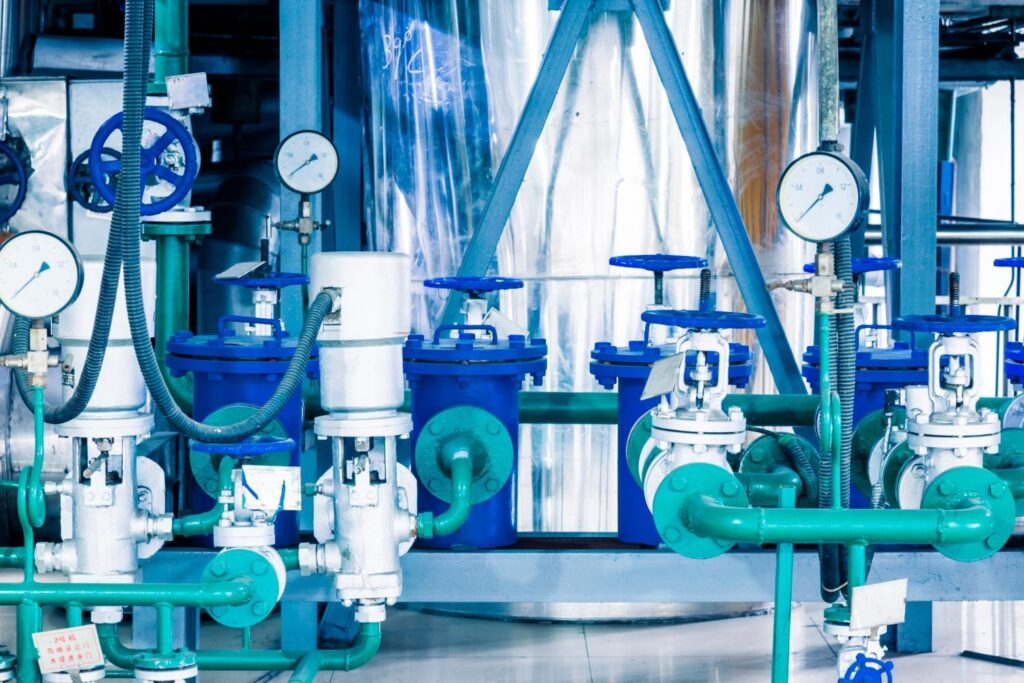
Choosing the right water pump is essential for moving fluids efficiently and reliably in industrial applications. However, different systems have different requirements for flow, pressure, head, fluid characteristics, and operating conditions.
A pump designed for clean boiler feedwater, for example, may not be suitable for wastewater containing sludge or suspended solids.
Understanding the different water pump types and their applications can help engineers, contractors, and plant operators make a more informed selection.
What Is a Water Pump?
A water pump is a mechanical device used to transfer water or other fluids through a system. Pumps add energy to the fluid so it can be moved through pipes, overcome elevation differences, or maintain the required pressure.
The Hydraulic Institute broadly classifies pumps into two main groups: rotodynamic pumps and positive displacement pumps. Rotodynamic pumps use a rotating impeller, propeller, or rotor to transfer energy to the fluid, while positive displacement pumps move a defined volume of fluid with each operating cycle.
This distinction is useful when determining which pump design is appropriate for a particular application.
Common Water Pump Types
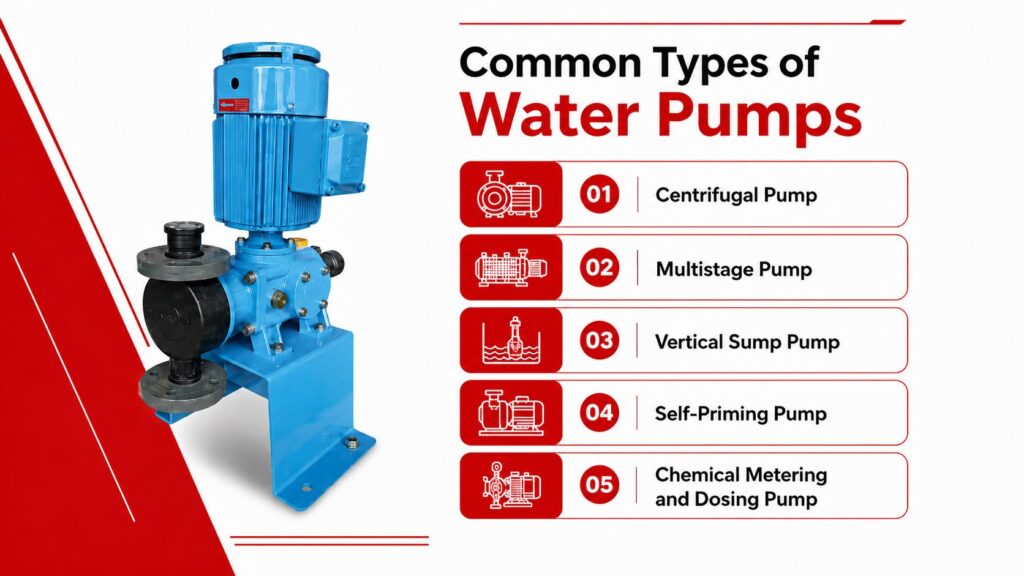
1. Centrifugal Pump
Centrifugal pumps use a rotating impeller to transfer energy to the fluid. They are widely used for continuous-flow applications such as water transfer, cooling systems, industrial processes, and wastewater systems.
The Hydraulic Institute identifies centrifugal pumps as a type of rotodynamic pump, alongside mixed-flow and axial-flow designs.
Apex Uniparts supplies the Kewpump KS MF, a back pull-out end-suction mixed-flow centrifugal pump for industrial applications.
2. Multistage Pump
Multistage pumps use multiple impellers or stages to generate higher pressure and head than many single-stage arrangements.
They are commonly used for applications such as:
- Boiler feedwater
- High-pressure water supply
- Industrial water systems
- Pressure boosting
The SIHI MSL Multistage Pump is designed for boiler feedwater applications, with a maximum capacity of 250 m³/hr and maximum head of 630 m. The SIHI HEGA Multistage Pump is another boiler feedwater option, with a maximum capacity of 100 m³/hr and maximum head of 395 m.
3. Vertical Sump Pump
Vertical sump pumps are designed for pumping liquids from sumps, pits, or tanks. Their vertical configuration can be useful for applications involving deep wells or submerged liquid sources.
The Kewpump VSP Vertical Sump Pump has a maximum capacity of 180 m³/hr and maximum head of 42 m. It is designed for handling polluted water, sediment sludge, scale, and slurries.
4. Self-Priming Pump
Self-priming pumps are designed to establish pumping action under suitable operating conditions without requiring manual priming each time. They can be useful where the pump is installed above the liquid source or where air may enter the suction line.
The SIHI ULNC Self-Priming Vacuum Deaerator Pump is designed for vacuum deaerator applications, with a maximum capacity of 300 m³/hr and maximum head of 95 m. Kewpump KS-SG2 Chemical Process Pump also offers self-priming pump solutions for applications in wastewater, power plants, chemical processing, and palm oil mills.
5. Chemical Metering and Dosing Pump
Chemical metering pumps deliver controlled quantities of chemicals into a process. They are commonly used in water treatment, wastewater treatment, boiler chemical dosing, and disinfection systems.
Apex Uniparts supplies Kewpump KDP, Kempion SP Series Metering Pump, and Uniflo V5-1560SS Metering Pump solutions. For example, the Kewpump KDP offers a maximum capacity of 30 L/hr for simplex operation or 60 L/hr for duplex operation, with a maximum pressure of 35 kg/cm².
The Kempion SP Series is designed for applications including boiler chemical and chlorine disinfectant injection, as well as water and wastewater treatment.
How to Choose the Right Water Pump
Selecting a water pump involves more than choosing the required flow rate. The pump must match the complete system and operating conditions.
The Hydraulic Institute recommends considering factors including the application, system design, pump type and speed, pump performance, materials of construction, and other specifications during the selection process.
1. Determine the Required Flow Rate
Flow rate refers to the volume of fluid the pump needs to move over a specific period.
Determine the actual flow required by the system rather than simply selecting a pump with the highest available capacity. Oversizing a pump can increase energy consumption and may result in inefficient operation.
2. Calculate the Required Head
Pump head represents the energy required to move the fluid through the system.
Consider:
- Vertical elevation
- Pipe length and diameter
- Friction losses
- Valves and fittings
- Required discharge pressure
For centrifugal pumps, manufacturers provide performance curves showing the relationship between flow and head. The U.S. Department of Energy notes that pump selection should consider the system’s required flow and head, as well as the pump’s efficiency and best efficiency point (BEP).
3. Consider the Fluid
The type of fluid being pumped can significantly affect pump selection.
Consider whether the fluid is:
- Clean water
- Wastewater
- Sludge or slurry
- Chemical solution
- Oil
- High-temperature fluid
- Contaminated with suspended solids
For example, the Kewpump VSP is specifically designed for polluted water, sediment sludge, scale, and slurries, while the Kewpump KS-SG2 is designed for applications including demineralised water, wastewater, chemical processing, pulp and paper, and heavy-duty industrial processes.
4. Check Operating Conditions
Consider how the pump will operate in the actual facility.
Important factors include:
- Continuous or intermittent operation
- Number of starts and stops
- Operating temperature
- Installation location
- Available power supply
- Maintenance access
These conditions can influence the pump type, materials, motor requirements, and overall configuration.
5. Consider Energy Efficiency and Operating Cost
Pump selection should consider more than the initial purchase price. Energy consumption, maintenance, replacement parts, servicing, and downtime can all contribute significantly to the total cost of operating a pumping system.
This is particularly relevant for Malaysian industrial facilities, where energy efficiency has become an increasingly important consideration. Malaysia’s Energy Efficiency and Conservation Act (EECA) 2024, enforced from 1 January 2025, establishes an energy-efficiency framework covering industrial and commercial sectors.
When selecting a pump, consider its operating efficiency, required flow and head, operating hours, and whether the system can be optimised to avoid unnecessary energy consumption.
Which Water Pump Is Right for Your Application?
Different industrial applications call for different pump designs.
| Application | Pump Type to Consider |
|---|---|
| General water transfer | Centrifugal pump |
| Boiler feedwater | Multistage pump |
| High-head water supply | Multistage pump |
| Polluted water and sludge | Vertical sump pump |
| Chemical processing | Chemical process pump |
| Water and wastewater treatment | Process or dosing pump |
| Chemical dosing | Metering or dosing pump |
The final selection should be based on the actual system requirements and the manufacturer’s technical specifications.
Water Pump Solutions from Apex Uniparts
Apex Uniparts supplies a range of water pump and industrial pump solutions covering applications across general industry, water and wastewater treatment, palm oil processing, power generation, and other industrial sectors. Its range includes Kewpump, SIHI, Flowserve, and chemical metering pump solutions.
Kewpump
The Kewpump range includes several pump designs for industrial applications.
The Kewpump KS MF is a mixed-flow centrifugal pump, while the Kewpump VSP is designed for polluted water, sludge, scale, and slurry applications. The Kewpump KS-SG2 is designed for chemical processes, wastewater, pulp and paper, and other heavy-duty industrial applications.
SIHI / Flowserve
Apex Uniparts supplies SIHI and Flowserve pumps for industrial and process applications.
The range includes SIHI MSL and HEGA multistage pumps for boiler feedwater, as well as the SIHI ULNC self-priming vacuum deaerator pump and Flowserve pumps for chemical and industrial process applications.
Chemical Metering Pumps
For applications requiring controlled chemical dosing, Apex Uniparts offers Kewpump, Kempion, and Uniflo solutions.
The range covers applications such as boiler chemical dosing, chlorine disinfection, water treatment, wastewater treatment, and other industrial chemical dosing processes.
Choosing the Right Water Pump Based on Your Needs
Choosing the right water pump starts with understanding the application and system requirements.
Consider the required flow rate, head, fluid characteristics, operating conditions, installation requirements, and long-term operating costs before selecting a pump type.
Pump efficiency should also be considered at the system level, rather than looking at the pump alone. Suruhanjaya Tenaga’s energy-efficiency guidelines identify pump systems, including components such as pumps, pipes and valves, as an area where system improvement and optimisation can be applied.
For example, a multistage pump may be appropriate for high-head boiler feedwater, while a vertical sump pump may be better suited to polluted water and sludge. Chemical dosing applications require a different approach, with metering pumps designed to deliver controlled quantities of chemicals.
Apex Uniparts provides pump selection, sizing, commissioning, technical support, and servicing to help customers identify suitable equipment for their applications.
Looking for the right water pump for your industrial application? Explore Apex Uniparts’ pump and industrial equipment range.